


I've been watching this Korean drama lately. Even though it's supposed to be set at Harvard, it was actually filmed at U So. Cal / UCLA. (I thought I caught a glimpse of a palm tree or two, which is rather strange for Harvard. The seashore scene is also decidedly un-Massachusetts like, and the clincher is the state highway signs are just like those in California.) For those who like romantic drama, it's a captivating story nonetheless. And of course the male leads are good-looking ;).
Surprisingly (to me, at any rate), the guy who played the strict Prof. Keynes is none other than Frank Gorshin. Frank who? Think "The Riddler" from the Batman TV series. I never woulda thunk it!
Showing posts with label Korea. Show all posts
Showing posts with label Korea. Show all posts
Wednesday, June 03, 2009

Monday, February 11, 2008
Thursday, January 17, 2008
The Aquariums of Pyongyang
I got The Aquariums of Pyongyang the other day. It is the eye-opening story of a nine-year-old boy who was sent, along with his father, grandmother, uncle, and seven-year-old sister, to one of the North Korean concentration camps. Their "crime"? The grandfather had been marked as a political enemy, which condemned the entire family (save the mother) to ten years in the gulag for "reeducation." It is nearly impossible for us to imagine life in the hellhole he describes, and what is even more astonishing is that the particular camp that he and his family were sent to wasn't even considered one of the hard labor camps. Imagine being brutally kicked and beaten for the merest infraction of the rules. Imagine being so hungry that you would literally eat anything that moved - centipedes, earthworms, salamanders, rats, frogs. Imagine working outside in single-digit (or colder) temperatures dressed in nothing but rags. Imagine cleaning out a latrine by hand. Imagine digging mass graves for the hundreds that didn't make it through the winter. Imagine plowing a field with rudimentary tools, and discovering rotting corpses in the overturned earth. Imagine that despite the horror of these conditions, there are other camps that are far more hellish.
The book is a very compelling read, and although I didn't intend to, I ended up reading the entire book from cover to cover in one day; it sounds like a cliche, but I really didn't want to put the book down. It should be required reading by anyone who thinks that man is basically good, or thinks that the efforts of man (i.e. socialism, fascism, communism) can create paradise on earth. It should be read by anyone who thinks that they can cozy up to a totalitarian regime and not get burned because they're somehow special or will be protected. (Liberals: You would do well to remember this about Islam.)
Like excrement, a purge starts at the top and runs downhill, sparing no one.
May God have mercy and depose the tyrant of Pyongyang. May He bring freedom and righteousness to that tortured nation.
The book is a very compelling read, and although I didn't intend to, I ended up reading the entire book from cover to cover in one day; it sounds like a cliche, but I really didn't want to put the book down. It should be required reading by anyone who thinks that man is basically good, or thinks that the efforts of man (i.e. socialism, fascism, communism) can create paradise on earth. It should be read by anyone who thinks that they can cozy up to a totalitarian regime and not get burned because they're somehow special or will be protected. (Liberals: You would do well to remember this about Islam.)
Listen: Whenever one of these despots gets into power, the first ones to be purged are always those who were unquestioningly faithful to the man and the principles - and the purge doesn't stop there.
Like excrement, a purge starts at the top and runs downhill, sparing no one.
May God have mercy and depose the tyrant of Pyongyang. May He bring freedom and righteousness to that tortured nation.
Friday, June 15, 2007
Workers' Paradise
I highly doubt Diane Sawyer saw any of these things on her trip to DPRK last year:
LiNK
street children
daily life
Too bad she didn't bother to ask about Camp 22, either.
LiNK
street children
daily life
Too bad she didn't bother to ask about Camp 22, either.
Tuesday, October 10, 2006
Pix from Korea - 2
 Traditional kitchen.
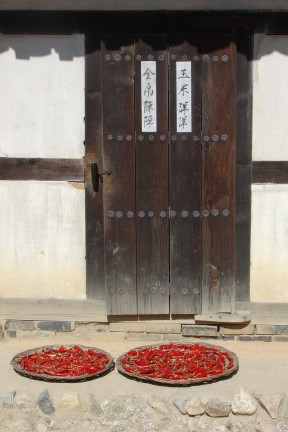 Hot peppers - the sine qua non of Korean cuisine.
 Korean houses were traditionally kept warm by heating the floors. The fire was built under the house.
 Edibles being hung to dry.
 Herbal medicine.
 Traditional apothecary and physician's office.
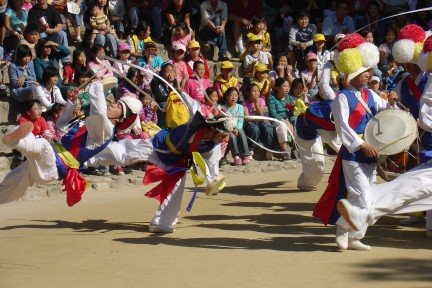 Traditional dancers.
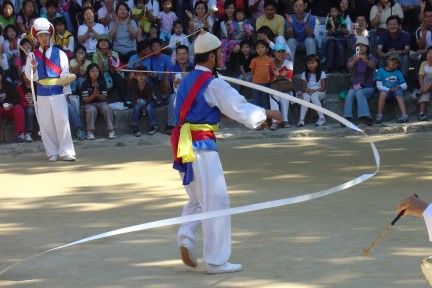 More traditional dancing.
 Seesaw girls. As if jumping into the air weren't enough, they're doing stunts as well.
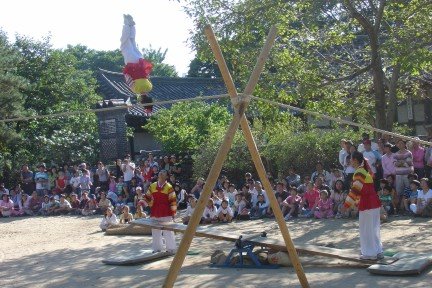 Acrobatics by the seesaw girls.
 Anybody can walk a tightrope, right?....
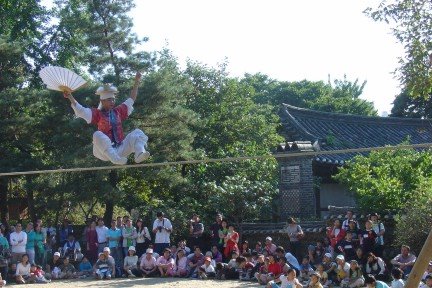 ...Now bouncing across a tightrope - that takes talent....
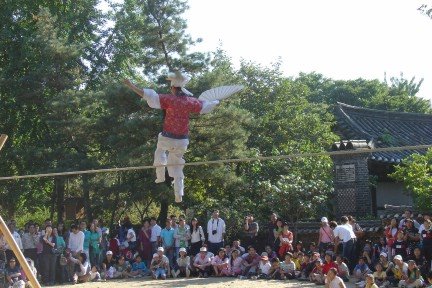 ...Or, how about reversing direction while you're bouncing?
 Korean stocks. There is also a huge stick with which to beat offenders.
 Equestrian acrobatics.
 More equestrian acrobatics.
 Traditional marriage ceremony.
 First of several courses of a sumptuous seafood dinner. The octopus still squirms even though it's been chopped up and put in the dish.
Pix from Korea
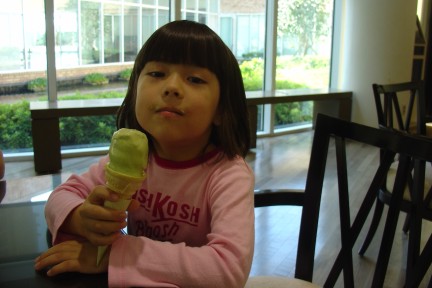 Green tea ice cream - yum, yum! Actually, it didn't taste too bad.
 One of the waterfalls on Jeju Island - a popular place for having one's picture taken.
 One of the few useful things about a Buddhist temple - the dragons double as a jungle gym.
 View from a scenic overlook on Jeju Island.
 Traditional housing on Jeju Island, with the "stone grandfathers."
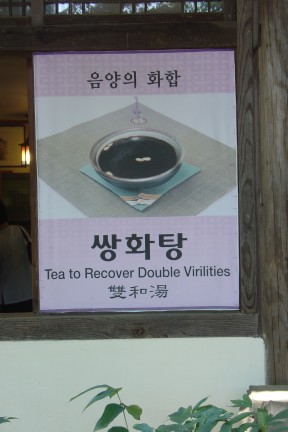 Who needs a little blue pill?
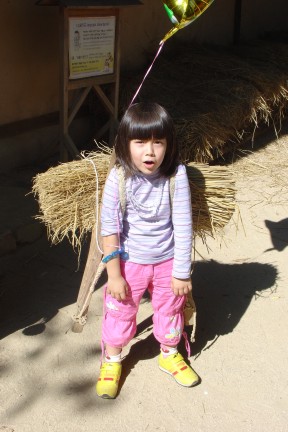 Might as well get'em used to slave labor while they're young.
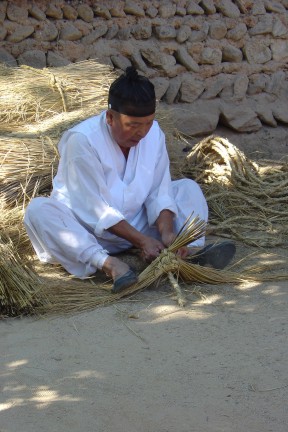 Traditional handcrafting.
Monday, October 09, 2006
Notes from Korea – Postscript
Well, we’ve been back from Korea for almost a couple of weeks now (finally over the jet lag, more or less – the kids are still sleeping somewhat late in the morning, but I’m not complaining about that), so I wanted to wrap this up with a few final comments and observations.
I would have loved to get a picture of the traffic, but without a video camera it is impossible to grasp the craziness of the drivers there. Driving in Seoul is not something that can be experienced vicariously; you must see it firsthand to believe it. The cardinal rule seems to be that traffic rules are suggestions at best. I saw motorcycles driving between lanes and on shoulders; I saw cars driving on shoulders; I saw right turns being made from left-hand lanes and left turns being made from right-hand lanes; I saw drivers slipping their cars into a lane where there was scarcely enough room for them to fit; I saw drivers jump the gun at stoplights – get the idea? I know I wouldn’t last fifteen seconds driving in that environment; it’s definitely not for the faint of heart. The best thing to do is to take the subway.
I used the subway extensively to get around for sightseeing, and for the most part, the system is fairly straightforward and easy to navigate. The majority of the signs are transcribed into the Western alphabet (as are the direction signs on the roads), so knowledge of the Korean alphabet is not necessary. The subways are convenient, and if you avoid obvious peak times like morning or afternoon rush, they aren’t terribly crowded. Carrying a child is often good for getting a seat, though, and if you do find yourself having to stand while bearing packages, it is likely that someone sitting will take your packages and hold them on their lap for you.
One thing that you do see in the subway stations, and even on the trains themselves, is peddlers and beggars. More than once I saw someone blind or crippled hobbling up and down the trains offering gum and the like for sale, or even just carrying a music box, hat in hand. I also saw an apparently able-bodied man hawking lower back supports (“As seen on TV!”), giving his spiel for a good ten minutes before he got off at the same station I did. Most of the time I did my sightseeing solo, but on a couple of occasions my daughter did witness the beggars, and asked about them. I admit that I don’t have any brilliant ideas on how to explain that type of thing to a four-year-old.
(Side note regarding subway stations (or other public facilities): If you see a vending machine located just outside the restrooms, and toiletries are in the vending machines, take that as a positive sign that the stalls lack toilet paper, and be prepared.)
There are other advantages to traveling with children, however. Children are a great icebreaker, and the Koreans all seemed to like children, especially babies. I lost track of how many people would kitchy-koo the baby and take pictures, commenting on how cute he was. Not only women would do this – I don’t find that too surprising, at any rate – but the young men would act that way too. Total strangers would offer to hold the baby at a restaurant, giving me the opportunity to eat in peace. Hannah also made an impression on those whom she met – she’d use whatever Korean she knew and just be her amiable self, winning hearts wherever we went. She also asked, “Why do people think I’m cute?” several times; I responded that I didn’t know, but I suspect that perhaps people are enamored of “mixed” children. I did meet one Korean woman (whose husband is American) on the subway; she was visiting her family and friends, and she said that she got similar reactions when she went out with her young child.
I wish that I could have spent more time in Korea. There’s a lot to do and see that I just didn’t get to do this time; there’s only so much that can be done in three weeks, especially when traveling alone with young children. But looking on the bright side: this gives me an opportunity to go back someday and see the things I missed – not to mention some of the things that I did see this time, but couldn’t look at in detail because certain munchkins got easily bored and were anxious to move on.
Here is a picture from our trip (I've been trying to upload more, but Blogger is being cantankerous, so I'll save them for another day):

Hotel room. Notice the absence of what we in the West would call a "bed." Instead, there are blankets and pads (thick blankets, in other words) to sleep on. Not all that bad, but it's not the most comfortable thing for someone with a backache, I think.
I would have loved to get a picture of the traffic, but without a video camera it is impossible to grasp the craziness of the drivers there. Driving in Seoul is not something that can be experienced vicariously; you must see it firsthand to believe it. The cardinal rule seems to be that traffic rules are suggestions at best. I saw motorcycles driving between lanes and on shoulders; I saw cars driving on shoulders; I saw right turns being made from left-hand lanes and left turns being made from right-hand lanes; I saw drivers slipping their cars into a lane where there was scarcely enough room for them to fit; I saw drivers jump the gun at stoplights – get the idea? I know I wouldn’t last fifteen seconds driving in that environment; it’s definitely not for the faint of heart. The best thing to do is to take the subway.
I used the subway extensively to get around for sightseeing, and for the most part, the system is fairly straightforward and easy to navigate. The majority of the signs are transcribed into the Western alphabet (as are the direction signs on the roads), so knowledge of the Korean alphabet is not necessary. The subways are convenient, and if you avoid obvious peak times like morning or afternoon rush, they aren’t terribly crowded. Carrying a child is often good for getting a seat, though, and if you do find yourself having to stand while bearing packages, it is likely that someone sitting will take your packages and hold them on their lap for you.
One thing that you do see in the subway stations, and even on the trains themselves, is peddlers and beggars. More than once I saw someone blind or crippled hobbling up and down the trains offering gum and the like for sale, or even just carrying a music box, hat in hand. I also saw an apparently able-bodied man hawking lower back supports (“As seen on TV!”), giving his spiel for a good ten minutes before he got off at the same station I did. Most of the time I did my sightseeing solo, but on a couple of occasions my daughter did witness the beggars, and asked about them. I admit that I don’t have any brilliant ideas on how to explain that type of thing to a four-year-old.
(Side note regarding subway stations (or other public facilities): If you see a vending machine located just outside the restrooms, and toiletries are in the vending machines, take that as a positive sign that the stalls lack toilet paper, and be prepared.)
There are other advantages to traveling with children, however. Children are a great icebreaker, and the Koreans all seemed to like children, especially babies. I lost track of how many people would kitchy-koo the baby and take pictures, commenting on how cute he was. Not only women would do this – I don’t find that too surprising, at any rate – but the young men would act that way too. Total strangers would offer to hold the baby at a restaurant, giving me the opportunity to eat in peace. Hannah also made an impression on those whom she met – she’d use whatever Korean she knew and just be her amiable self, winning hearts wherever we went. She also asked, “Why do people think I’m cute?” several times; I responded that I didn’t know, but I suspect that perhaps people are enamored of “mixed” children. I did meet one Korean woman (whose husband is American) on the subway; she was visiting her family and friends, and she said that she got similar reactions when she went out with her young child.
I wish that I could have spent more time in Korea. There’s a lot to do and see that I just didn’t get to do this time; there’s only so much that can be done in three weeks, especially when traveling alone with young children. But looking on the bright side: this gives me an opportunity to go back someday and see the things I missed – not to mention some of the things that I did see this time, but couldn’t look at in detail because certain munchkins got easily bored and were anxious to move on.
Here is a picture from our trip (I've been trying to upload more, but Blogger is being cantankerous, so I'll save them for another day):
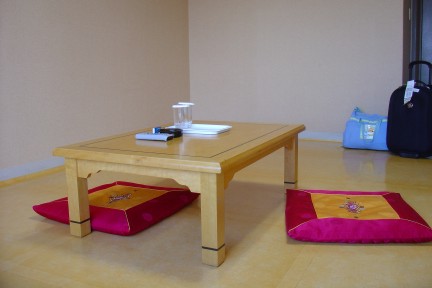
Hotel room. Notice the absence of what we in the West would call a "bed." Instead, there are blankets and pads (thick blankets, in other words) to sleep on. Not all that bad, but it's not the most comfortable thing for someone with a backache, I think.
Saturday, September 16, 2006
Notes from Korea – 3
 Today we went on a cruise of the Han River (the major river in Seoul). The theme of the tour was “pirates,” and they entertained the kids with a magic show. The cruise was an enjoyable way to see the city from a little different perspective. This building is the National Assembly - meeting place of the people's elected representatives.
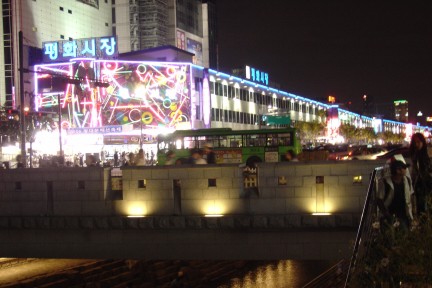 Then in the evening I went to Dongdaemun, one of the well-known shopping districts in Seoul. “Shopping district” is putting it mildly, really – think of it as one huge bazaar. You could never have anything like this in the States due to zoning laws. In Dongdaemun you can walk up and down main streets and alleyways and find countless booths/tents selling all kinds of things, from shoes to socks, backpacks to bedspreads, blue jeans to traditional Korean costumes – not to mention the multitudes of food tents here and there selling every kind of Korean food imaginable. Some booths are literally a hole in the wall, while others are tents set up on the sidewalks and even in the middle of the street. I found it fascinating, because it is so different from what we are used to in the hyper-regulated, hyper-zoned U.S.
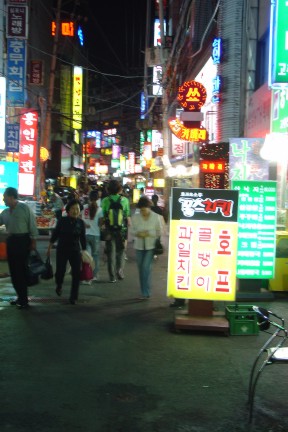 Restaurant Alley. You can find all sorts of Korean food here, and if you have crab, you know it's fresh - you can see it swimming in the tank outside the eating establishment.
 Guess where these booths are? They're in the underground crosswalk - every which way you turn, there is a booth with someone peddling something or another. If you want it, someone's sure to have it available.
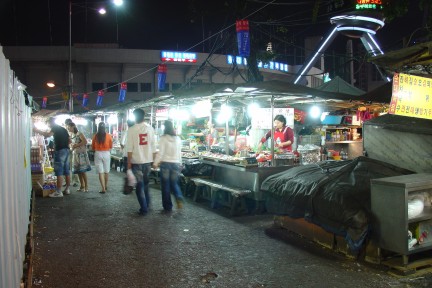 Hungry? No problem - there are plenty of food tents to satisfy your cravings.
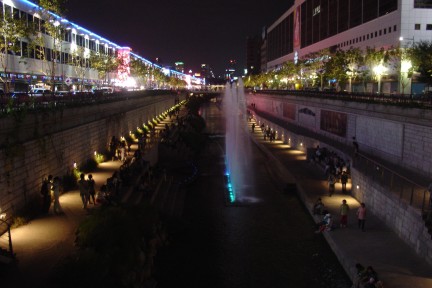 In this district there is also the river Cheonggyecheon, a river that had been that had been covered up but is now restored, with walkways along the banks and colored fountains to watch. It is a nice contrast to the hustle and bustle of Seoul city life.
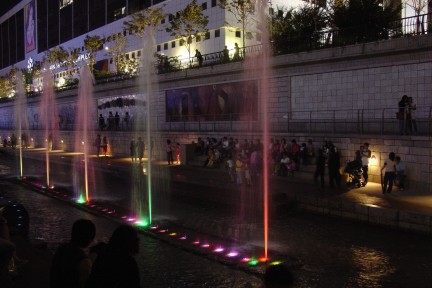 Seoul's own "riverwalk." It's little more than a stream, so of course there are no boat tours here.
Friday, September 15, 2006
Notes from Korea – 2
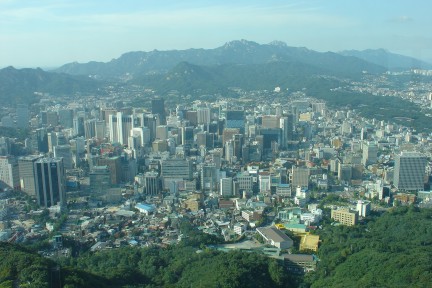 Been doing some more sightseeing. On Tuesday Hannah and I took a city bus tour to get a general sense of the city and the different things there are to see. The bus tour is such that one can get off at any designated point and sightsee there, then hop on the next bus to continue the tour. I was mainly interested in getting an overview of the city, so we primarily rode around. However, we did get off at Seoul Tower, which is a spire situated on top of a large hill and consequently offers a 360-degree view of the city. This picture shows the view looking north over the city. Pyongang (in N. Korea) is about 130-some km in this direction. Chicago lies about 120 degrees clockwise and 10,500 km from this point.
Then on Wednesday I entered the city alone (much easier to navigate the subway system without dragging two small children around) and made my way to Yonsei University, which has a renowned Korean Language Institute. My main objective in that visit was to check out the Korean language materials available. I managed to pick up a number of textbooks to help me advance in the language.
Today I ventured into town again (alone – and it’s a good thing, because the subway was SRO, and we were crammed in like sardines there for a while, without any pushers, thank you :) ), first to check out Kyobo Bookshop, which happens to be the largest bookstore in Korea. I picked up a Korean-English (NKJV) Bible, a couple of children’s Bibles, a manga version of the Old Testament as well as one of Genesis (yes, I know, I don’t really care for that style of animation/illustration – but I find comics extremely helpful in language learning, and they don’t seem to have enough taste or good sense to have any Carl Barks’ (or any other illustrator, for that matter) Donald Duck, so it’s either Bible stories or Pokemon-type of stuff – well, given that choice, guess which one I prefer?), a children’s book of stories such as Sinbad the Sailor and Peter Pan, and a children’s book of modern Korean tales. There is also a children’s book of traditional Korean folktales that I’d like to get, but I didn’t see it – perhaps on my next shopping trip.
Weighted down with all these books, I then did a little sightseeing. I went down the street (past the American Embassy, outside of which was crawling with police in riot gear because the place is a magnet for protestors and other rabble-rousers) to the palace Gyeongbokgung at Gwanghwamun. There is a changing-of-the-guards ceremony every hour on the hour, and I managed to get there just in time to witness this. The following pictures are from the ceremony and the palace grounds.
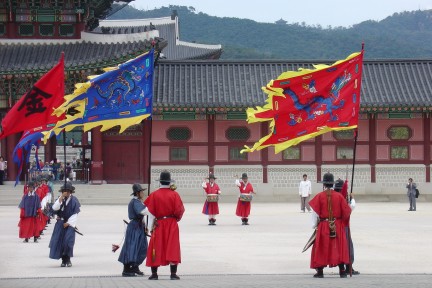
The changing of the guards.

One of the various ranks in the military at the time.

Another rank. Obviously an archer.
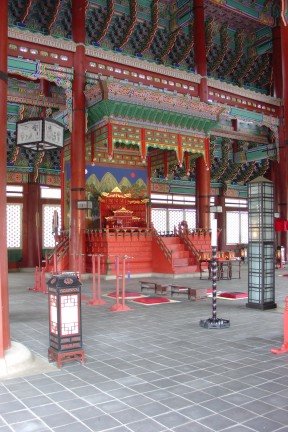
This is where coronations were held and official business was conducted. It was actually rather dark inside the building - I tried to expose for the interior so the various details could be seen.
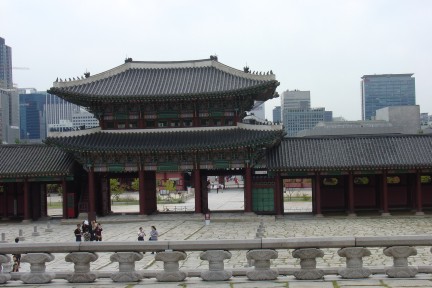
Contrasting old and new. It's pretty amazing how the two co-exist side by side in this incredibly crowded city.

A group of schoolkids on a field trip.
Sunday, September 10, 2006
Notes from Korea – 1
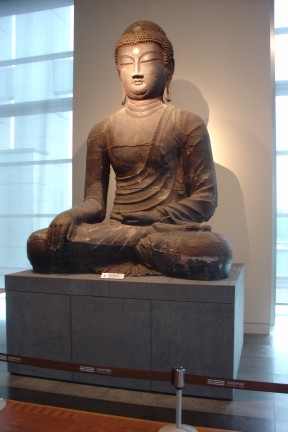
Yesterday we visited the National Museum of Korea, which has numerous national treasures such as ancient maps, royal artifacts, Buddhist sculptures, calligraphy, ceramics, and the like. The museum was completed in October 2005 after eight years of construction.
(Buddhas always give me the creeps.)
Today we did a little sightseeing after church and visited Deoksugung Palace in Seoul. According to the info on the ticket,
“Deoksugung Palace was originally built as a residence for Prince Wolsandaegun, the elder brother of King Seongjong. In 1593, about a century later, King Seonjo returned to Seoul after the Japanese invasion of 1593 and established a temporary residence here.Here are some pics from today.
“Haenggung, as it was called, was renamed Gyeongungung by the next ruler, Gwanghaegun. After King Injo held a coronation ceremony in Jeukjodang Hall and moved to Changdeokgung Palace, Deoksugung Place remained vacant for about 200 years.
“In 1897, King Gojong took up residence in Changdeokgung Palace as a main palace. In 1907, he abdicated his throne to King Sunjong. Since then, the palace has been known as Deoksugung.
“Deoksugung Seokjojeon was constructed in 1909 and has been used as a part of the Royal Museum since 1992.”

Detail of the eaves of one of the buildings on the palace grounds.
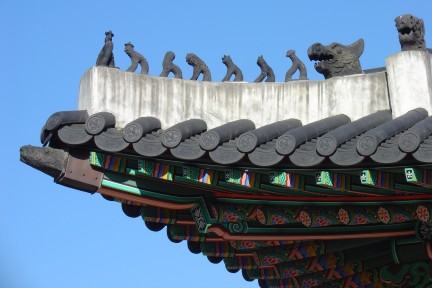
Detail of the roof of one of the buildings on the palace grounds.

One of the buildings on the palace grounds.

Kids will be kids - musty old artefacts and historical displays are on the boring side, so you have to make your own fun.

On the other hand, if you're young enough, you really don't care one way or the other, as long as your tummy's full and your diaper's not.
And now for some singularities:
At the National Museum, there were no water fountains. Instead, there were water coolers, with little paper envelopes that were used as drinking cups.

Up until today, I had only heard about these things:
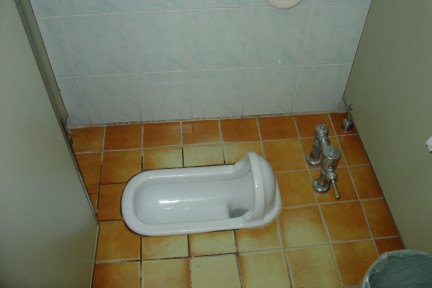
Thankfully, there were Western options available.
Friday, March 24, 2006
The Most Wretched Place on Earth

To witness the horrors of communism, visit here. Click "Enter" and wait for the slide show to start. The text is in Korean, but the pictures speak for themselves. This picture is actually one of the tamer ones. More pictures can be seen by clicking the icon in the lower left corner. Be sure to look at all the pages.
If anyone is tempted to believe in the so-called inherent goodness of man, this should cure them. This suffering is just one result of man's inhumanity to man, to say nothing of the persecution, torture, and killing of believers under the ruthless hand of Kim Jong-Il.
Subscribe to:
Posts (Atom)

 Posts
Posts


